I’ve spent most of my working life sitting across the table from people who, by any reasonable measure, have done well.
They’ve worked.
They’ve saved.
They’ve been responsible.
They fully own their home - or are close to it.
They have retirement savings.
They’re not reckless.
And yet, somewhere along the way, many of them find themselves feeling more constrained than they expected to be at this stage of life.
Not because something has gone wrong.
But because what they’ve built doesn’t seem to be offering the flexibility and choices they assumed it would.
This is especially common for homeowners nearing or in retirement.
“Many of them find themselves feeling more constrained than they expected to be at this stage of life.”
Often, they’re told some version of the same few things.
“You’ll need to keep working longer.”
“You may need to sell.”
“You’ll probably have to compromise your lifestyle.”
“It’s not quite time yet.”
That’s where the discomfort creeps in.
It’s not necessarily panic, or desperation. It’s more the sense that something doesn’t quite add up.
They think they should have more options at this point than the ones being put in front of them.
I.e. “We’ve done everything we were supposed to do - so why does this still feel so tight?”
In my experience, this is rarely about a lack of effort, discipline, or responsibility.
More often, it’s that the options haven’t been properly explored, or explained in a way that reflects the whole reality of someone’s life and what they’ve built.
Homes, savings, income, and future needs are often considered separately (siloed) - and it can be surprisingly rare for someone to sit down and look at how they interact in your specific situation.
When this happens, people can start to feel boxed-in.
It can start to feel as though the only way forward involves giving something up.
And the advice, often from well-meaning financial advisors, often collapses into the same few conclusions:
Work longer.
Sell.
Downsize.
Wait.
It’s no wonder some people start to feel stuck - as though every option comes with a trade-off.
However, in my experience, these ‘options’ are rarely the only ones available. Sometimes, there are practical options available that simply weren’t part of the conversation.
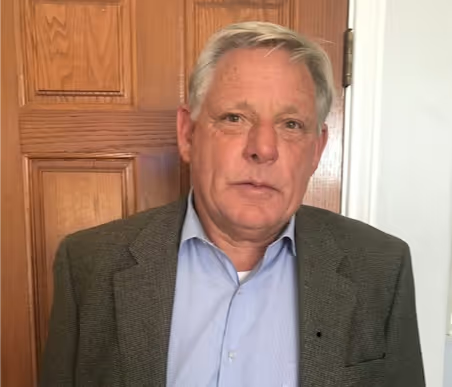
My name is David Marrs.
For over 20 years, my work has involved sitting down with people who feel boxed in by their financial situation, and helping them understand what options actually exist, and which don’t.
I don’t run a large firm, and I’ve never been interested in doing this at volume. Most of the people I speak with come through referral.
That’s intentional. These conversations require time, care, and judgment. They’re not suited to a conveyor belt, and they’re not for everyone.
Over the years, I’ve learned that when you slow the conversation down, something important becomes possible.
Most financial discussions move too quickly to conclusions.
They start with assumptions, rules of thumb, or a product category, and they end with the same familiar answers.
What I do is different.
I start by understanding what you actually want your life to look like, and what you’re trying to protect.
Then, I look at how everything is currently arranged, and where the pressure is really coming from.
Very often, the “answer” isn’t that someone needs to work longer or give up their home.
They’ve just never been shown how the pieces of their situation can be structured differently to produce more optionality.
And yes, in some cases, there are practical options available that simply weren’t part of the conversation you were having.
Whatever the outcome, simply knowing, with confidence, what is and isn’t possible and why can provide relief.
Over the years, I’ve learned that when people are given the space to slow the conversation down, something important changes.
“Sometimes what’s missing is a part of the picture that was never properly explained.”
Not a pitch.
Not a plan.
Not a push toward a decision.
Just a calm, honest look at how things actually work — and what options genuinely exist, and which don’t.
Even when no action follows, the sense of pressure often lifts.
People stop feeling as though they’re missing something obvious, or failing to see what everyone else can see.
“The pressure lifts when the picture becomes clearer.”
That sense of orientation matters more than most people realise.
“These conversations aren’t suited to volume.”
Again, I don’t work with large numbers of people, and I don’t try to.
Conversations take time, care, and judgment. Many conversations go no further than helping someone understand where they truly stand.
Again, often, that understanding alone changes how the future feels.
This page isn’t here to persuade you of anything. It exists to help you decide whether a conversation like this might be useful.
There’s no obligation, no pressure to act, and no expectation that it will lead in a particular direction.
Each situation is different. The value is in talking it through properly.
People who reach out are often trying to make sense of questions such as:
Whether retirement is actually possible without selling their home.
Whether what they’ve built is truly working for them.
How to reduce pressure without taking irreversible steps.
How to think about the future without dismantling the present.
How to create more certainty for the people they care about.
If you’re reading this and recognise yourself in any of it, the next page simply explains what happens if you do decide to get in touch, how the conversation usually works, and what to expect.